Media Measurement Matters: Estimating the Persuasive Effects of Partisan Media with Survey and Behavioral Data
Publication information:
Abstract
- Featured in MIT News
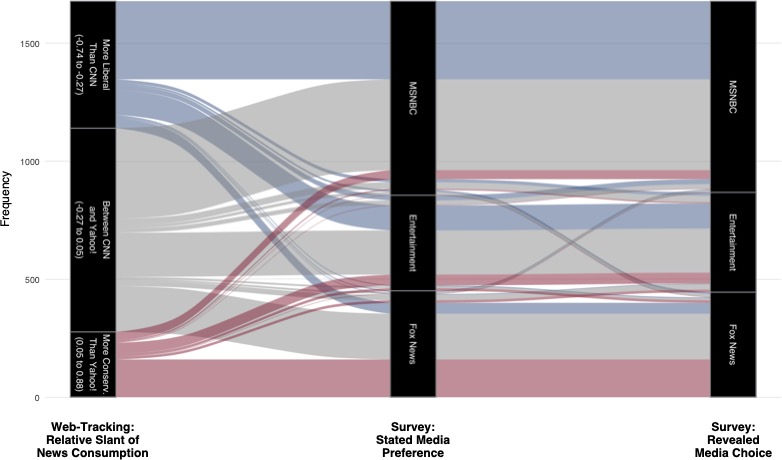
To what extent do partisan media influence political attitudes and behavior? Although recent methodological advancements have improved scholars’ ability to identify the persuasiveness of partisan media, past studies typically rely on self-reported measures of media preferences, which may deviate from real-world news consumption. Integrating individual-level web-browsing data with a survey experiment, we contrast survey-based indicators of stated preferences with behavioral measures of revealed preferences based on the relative volume and slant of news individuals consume. Overall, we find that these measurement strategies generate differing conclusions regarding heterogeneity in partisan media’s persuasive impact. Whereas our stated preference measure raises the possibility of persuasion by crosscutting sources, our revealed preference measures suggest that, among consumers with more polarized media diets, partisan media exposure results in limited attitude change, with any observed effects driven primarily by politically concordant sources. Together, these findings underscore the importance of careful measurement for research on media persuasion.